In and around Yellowstone National Park, the Yellowstone River is home to native Yellowstone cutthroat trout and mountain whitefish alongside nonnative rainbow and brown trout. Inside the park, cutthroat dominate much of the river. As the Yellowstone leaves the park near Gardiner and flows through Paradise Valley, you’ll find all four.
Farther downstream, especially below Billings, the river becomes warmer and supports a much broader mix of fish, including sauger, channel catfish, paddlefish, and sturgeon.
If you’re fishing the upper part of the river, it comes down to four main fish: Yellowstone cutthroat trout, brown trout, rainbow trout, and mountain whitefish.
Quick Glance at Yellowstone River Fish
Out of the 60+ species in the 671-mile-long Yellowstone River, these are the fish you’re most likely to encounter inside Yellowstone National Park and throughout the river’s upper section.
| Fish species | Status | Where you’ll find it |
|---|---|---|
| Yellowstone cutthroat trout | Native | Inside Yellowstone National Park and common from Gardiner through Paradise Valley, declining downstream of Livingston |
| Rainbow trout | Nonnative | Below the Upper Falls; common from Gardiner through Paradise Valley and farther downstream |
| Cutbow (cutthroat × rainbow hybrid) | Hybrid | Below the Upper Falls where cutthroat and rainbow trout overlap |
| Brown trout | Nonnative | Below Knowles Falls in the park; increasingly common from Gardiner through Paradise Valley and downstream |
| Mountain whitefish | Native | Below the Lower Falls and throughout the upper Yellowstone in Montana |
How to Tell Yellowstone River Fish Apart
These fish are fairly easy to tell apart using their color, spotting patterns, fin markings, body shape, and the cutthroat’s telltale throat slash.
Yellowstone Cutthroat Trout
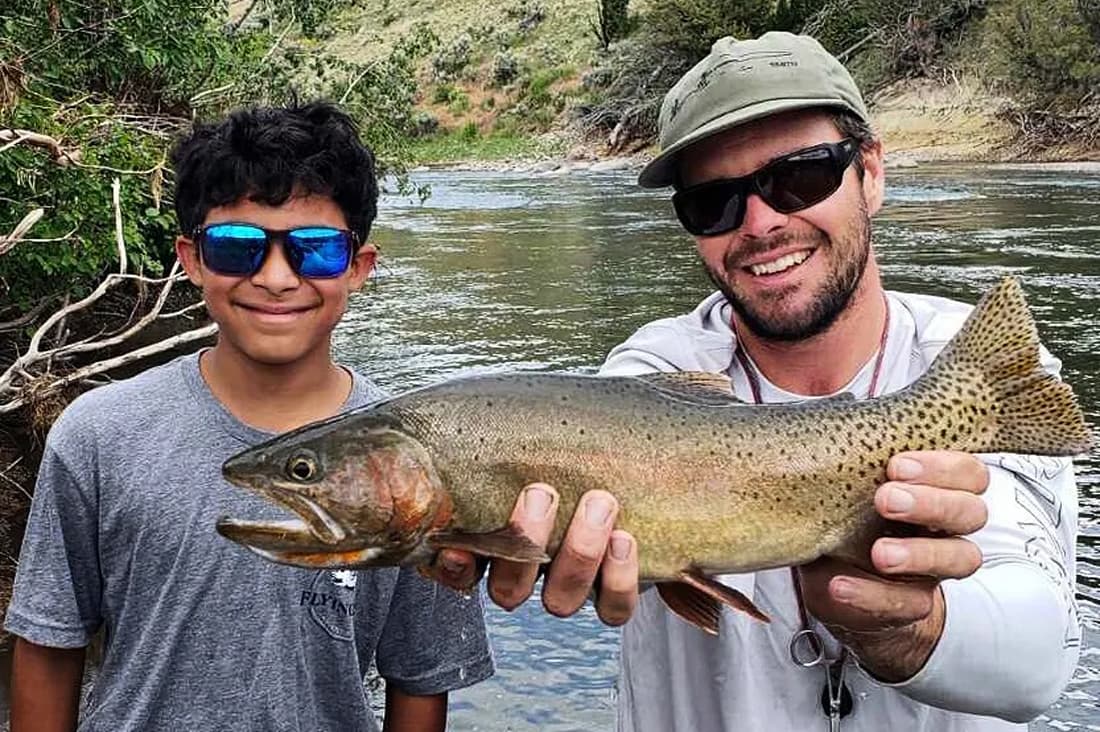
Look for the distinctive red-orange slash under the jaw and black spots, with few or none on the head.

Rainbow Trout and Cutbows
Rainbow trout typically have a pink or red stripe along their sides, numerous black spots, and often white edges on their lower fins. Cutbows (cutthroat-rainbow hybrids) can show features of either parent which can make them harder to identify.

Brown Trout
Brown trout have an olive, brown, or yellowish body with black spots surrounded by pale halos and often red or orange spots along their sides.

Mountain Whitefish
Mountain whitefish have a silvery or olive-gray body without spots, a small downturned mouth, and a deeply forked tail.

Fishing on the Yellowstone River, Inside the Park
Inside Yellowstone National Park, the types of fish you’ll find depend largely on where you go.
Yellowstone Lake to the Grand Canyon of the Yellowstone
The Yellowstone flows out of Yellowstone Lake at Fishing Bridge and north through Hayden Valley. This is Yellowstone cutthroat trout country. Cutthroat are the only trout species in this section of the river because the falls downstream prevent nonnative trout from moving upstream.
Cutthroat near the Yellowstone Lake outlet often run into the high teens, with fish over 20 inches possible. In the fishable canyon water farther downstream, cutthroat in the 12- to 17-inch range are more typical.
For anglers, this is one of the best places to fish for native Yellowstone cutthroat in their home waters. Plan around the calendar and closures: this stretch opens July 1 rather than with the park’s general season, and Fishing Bridge and nearby sections of the river are permanently closed to fishing.
Below the Grand Canyon to Gardiner, MT
Below the Grand Canyon, the mix of fish changes. You’ll find Yellowstone cutthroat plus rainbow trout, cutthroat-rainbow hybrids known as cutbows, and native mountain whitefish. Brown trout also live farther downstream, below Knowles Falls, a small waterfall in the Black Canyon of the Yellowstone upstream of Gardiner.
By the time the river reaches Gardiner at the park’s northern boundary, anglers can catch several species in the same river.
Fishing on the Upper Yellowstone River, Outside the Park
When the Yellowstone River leaves the park at Gardiner, it flows through one of Montana’s best-known trout fisheries. From Gardiner through Paradise Valley toward Livingston, anglers can catch Yellowstone cutthroat trout, rainbow trout, cutbows, brown trout, and native mountain whitefish.
Cutthroat are more common near Gardiner, while rainbow and brown trout increase farther down Paradise Valley. Mountain whitefish are especially abundant throughout this stretch and are frequently caught alongside trout. Most trout run roughly 12 to 18 inches, with fish over 20 inches possible.
This section of the Yellowstone is big, free-flowing water, so much of the fishing is done from a drift boat, with stops to wade productive runs and banks. It’s common to catch more than one species in a day, which is why this section is a popular choice for visitors.
Browse our guided fly fishing trips to see which one fits your group.
Fish in the Lower Yellowstone River
The trout fishery continues well beyond Livingston. Through Big Timber, Columbus, and toward Laurel, rainbow and brown trout remain important, although overall trout numbers gradually decline. This stretch can also produce some of the river’s largest brown trout, including fish over 20 inches. Yellowstone cutthroat become increasingly rare as you travel downstream.
Around Laurel and Billings, the Yellowstone begins changing from a cold-water trout river into a warmer prairie fishery, where sauger, channel catfish, burbot, smallmouth bass, and walleye become more prominent.
Farther east, the river supports an even broader mix of fish, including goldeye, shovelnose sturgeon, and paddlefish. The lower Yellowstone also holds endangered pallid sturgeon, which cannot be harvested.
Fish You Won’t Catch in the River
Lake trout live in Yellowstone Lake, not in the river below it, and there are no salmon anywhere in the Yellowstone River. If you’ve heard anglers talking about the salmonfly hatch, that’s an insect, not a fish, and it’s one of the best hatches of the year.
Fishing Rules in and Around Yellowstone
Inside Yellowstone National Park, anglers 16 and older need a park fishing permit. All native fish must be released, while rainbow trout, brook trout (rare in the main river), and identifiable cutbows caught in some sections of the Yellowstone River must be killed. Check current park regulations before fishing.
Outside the park, a Montana fishing license is required. For a full breakdown of permits, licenses, and where you’re allowed to fish, see our guide: Can You Fish in Yellowstone?
Fish the Yellowstone With a Guide
The Yellowstone River is one of the few places left where you can catch a native trout in the water it evolved in, surrounded by the same mountains it’s been running through the whole time. Our guides fish it every day and know which stretch is producing.