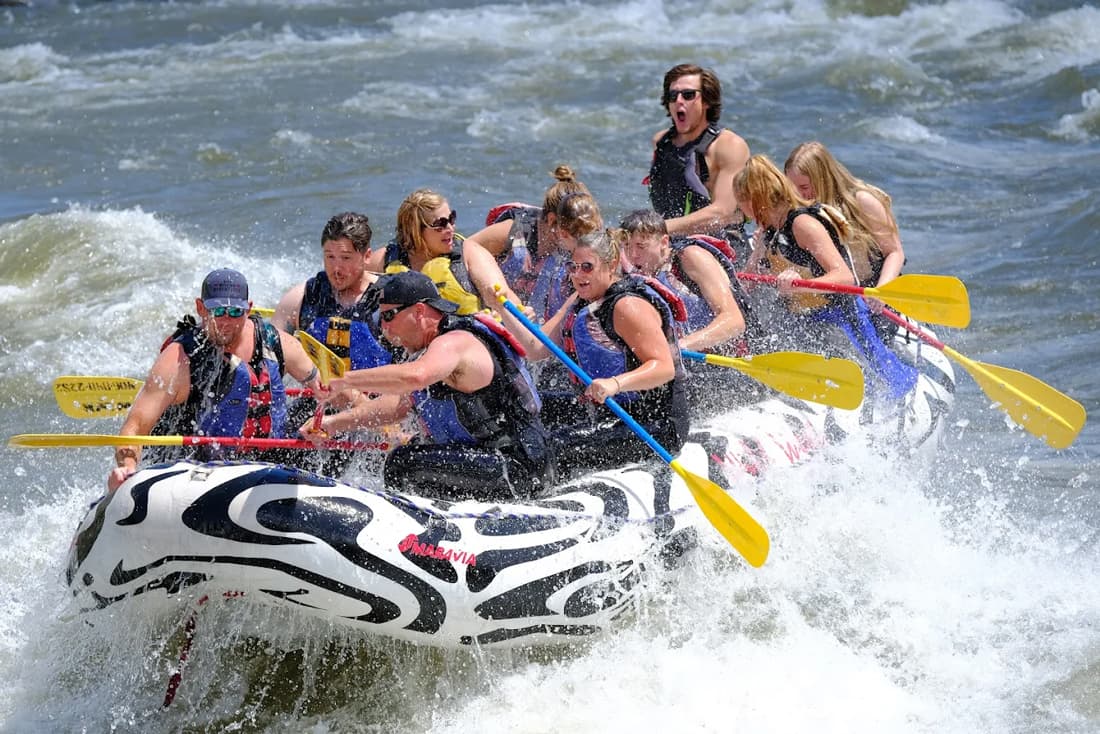
Whitewater rafting guests enjoying a wave train on the Yellowstone River. ©WWR
Most Yellowstone River rapids between Gardiner, MT and Paradise Valley, MT fall in the Class I to III range, with Yankee Jim Canyon becoming Class III–IV during high water.
Rapids are rated on a scale from Class I (gentle) to Class VI (unrunnable). For a full breakdown of each rapid class, check out our post What Are the Different Whitewater Classes?.
Yellowstone River Rapids at a Glance
Here are the rapids and their classes, as you head downriver from Gardiner, MT:
Scenic Stretch (Class I–II)
- Gentle current and small waves
Town Stretch (Class II–III)
- Queen of the Waters (Class II)
- The Chute (Class II)
- Man Eater (Class III)
- Sleeping Giant (Class II)
Yankee Jim Canyon (Class III, up to IV in high water)
- Revenge (Class III)
- Big Rock (Class III)
- The Pinch (Class III)
- Boxcar (Class III)
Below Yankee Jim, the river opens into Paradise Valley and mellows to Class I–II with mostly easy riffles. It’s beautiful water, but you won’t find big rapids between there and Livingston.
Scenic Stretch: Class I–II
This upper section near Gardiner has gentle current, small waves, and plenty of time to look around. It’s also the wildlife corridor in and out of Yellowstone, so watch the banks for elk, deer, eagles, and the occasional bear.
We run scenic float trips here. Your guide paddles while you relax and stay as dry as you want. It’s a good option for families with infants, grandparents, or anyone who wants time on the water without big Yellowstone River rapids.
Town Stretch: Class II–III
This 8-mile section is where whitewater rafting near Gardiner really starts. Class II and III rapids come quickly for the first few miles: Queen of the Waters, The Chute, Man Eater, Sleeping Giant. Expect bigger waves, faster current, and plan on getting wet.
After that initial stretch, the river alternates between rapids and calmer water, great for taking a dip. Your guide knows the good swimming holes for hot days.
Yankee Jim Canyon: Class III–IV

Boxcar Rapid in Yankee Jim at 25,000 CFS
Below the Town Stretch, the Yellowstone goes through a granite gorge with the biggest whitewater rapids on the river. When water is high (typically May through late June), these Class III rapids often become Class IV.
Four exciting rapids await:
- Revenge: A long wave train with stacked waves. Continuous paddling, serious splashes.
- Big Rock: A house-sized boulder creates a hole that crashes down on the raft.
- The Pinch: The canyon’s narrowest point. Lateral waves hit from both sides.
- Boxcar: The big one. It’s flipped boats over the years. Most trips take the safer line, but it still gets hearts pounding.
If you’re looking for big waves and exciting thrills, Yankee Jim is the best whitewater on the Yellowstone River.
How Water Levels Change the Rapids
In May and June, runoff from snowmelt makes waves bigger, rapids more continuous, and Yankee Jim Canyon is at its most intense.
By July, the river balances out and is ideal for families and first-timers who want real whitewater. In August and September, water levels drop, rapids mellow, and trips become fun floats in beautiful scenery.
Most guests have the best experience from late June through August when the water is warm enough to enjoy swimming holes and the rapids still have plenty of energy.
Experience the Rapids of the Yellowstone
The Yellowstone River has rapids for everyone: relaxing, calm water, fun bumps and splashy sections, and the exciting Class IV rapids in Yankee Jim Canyon.
Not sure which section will work for your group? Check out our whitewater rafting trips or give us a call at (406) 848-2252.
We run these Yellowstone River rapids every day and can help you pick the right trip for your experience level and what you’re hoping to get out of your day on the water.