We’ve been guiding trips on the Yellowstone River for more than 30 years, on water that runs anywhere from Class II to Class IV depending on the trip and the time of season. Here’s our take on what Class III rapids are, what can go wrong, and how to tell whether they’re right for your whitewater rafting trip.
What Are Class III Rapids?
All rapids are rated on the International Scale of River Difficulty, published by American Whitewater. The scale runs from Class I (gentle current, small waves) to Class VI (essentially unrunnable). For the full breakdown of every class, see What Are the Different Whitewater Classes?
Class III is in the middle, and the scale labels it “intermediate.” The official description is worth reading closely if you’re nervous: Class III rapids are moderate, irregular waves that can be hard to dodge, fast current, and strong eddies. Injuries while swimming Class III are rare, and self-rescue is usually easy.
Here’s what the rating won’t tell you: it changes as water levels shift. During snowmelt runoff, waves get bigger and a rapid rated Class III can run like a Class IV. By late summer, when flows drop, that same rapid spreads out into smaller, friendlier waves closer to a Class II.
American Whitewater is upfront that the scale isn’t exact, and that a Class III on one river can feel like a Class IV on another. We break down how that plays out on our water in What Class Rapids Are on the Yellowstone River?
Treat the rating as a starting point, not an exact science. Then call your whitewater outfitter and ask what the river is actually doing that week.
How Dangerous Are Class 3 Rapids?
Class III carries risk, though again, experienced commercial guides mitigate risks with expert paddling and a deep knowledge of the river. Here’s where risks typically come from:
- Cold water is easy to underestimate. In late spring and early summer, temperatures are cool and rivers usually run on snowmelt. A swim in cold water takes your breath and your strength faster than you’d expect. That’s why wetsuits and splash jackets exist, and why we offer them early in the season.
- Falling out can happen on Class III, usually in a wave train, but it usually ends within a few seconds.
- Bumps and bruises from the raft, a paddle, or a rock in a shallow spot sometimes happen.
- Sun and dehydration, especially on a hot summer day, cause more trouble than the rapids.
Class III is also a long way from the top of the scale. If you want to know what genuinely dangerous whitewater looks like, see Are Class 5 Rapids Dangerous?
It’s important to know that a guided commercial trip through Class III has a different risk profile than two friends running the same rapid in their own boat. You’ll get a guide who has run that exact stretch hundreds of times, a Coast Guard-approved life jacket fitted to your body, a safety talk before you launch, and calm water below the rapid where a guide can pick up a swimmer.
If you do swim, you’ll already know what to do, because your guide will have walked you through it: on your back, feet up, pointed downstream. Your life jacket does the floating, so you don’t need to be a strong swimmer. Our guides are certified in Swiftwater Rescue, First Aid, and CPR. Plenty of guests jump in on purpose during the calm stretches.
For a broader look at rafting risks, see Is Whitewater Rafting Dangerous?
What Class III Actually Feels Like

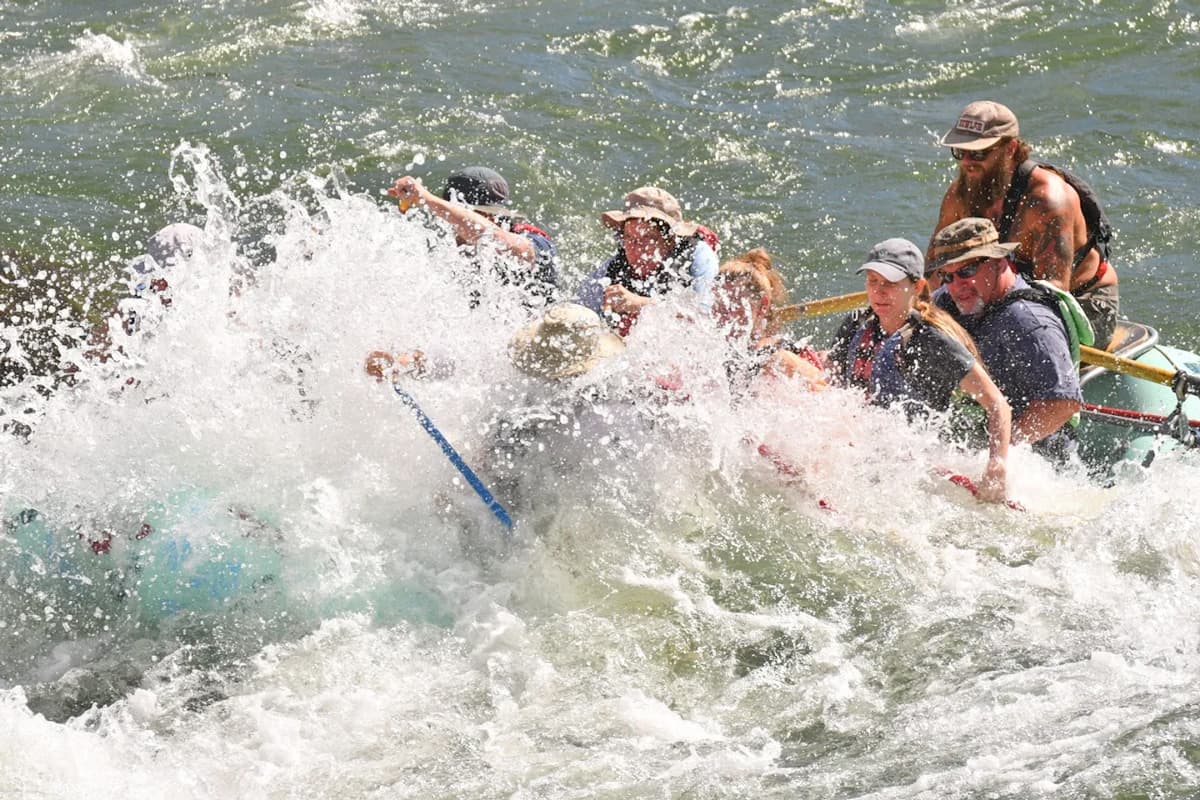
You’ll splash through exciting waves 2–5 feet tall (depending on water flow) as the bow rises and drops. Expect water to come over the front of the raft—you will get wet! Your guide will shout commands to paddle, so please paddle! Class III is something you participate in, not something you ride through.
Big Rock, in Yankee Jim Canyon, is a good example of what a Class III feature can look like. A boulder the size of a house sits in the current and splits the river in two. From the raft it looks enormous, and you’re splashing through a thrilling hole that crashes down on the bow. Then it’s behind you, you’re soaked, and everyone in the boat is laughing.
Should You Book a Class III River Trip?
Say yes if you can follow directions, hold a paddle, stay seated, and don’t mind getting wet. You don’t need experience, strong swimming skills, or serious fitness.
For kids, most outfitters use a weight minimum rather than an age minimum, because their life jacket has to fit correctly. Ours is 40 pounds, which usually works out to about age 4 and up. Guides seat younger or more nervous kids toward the middle of the raft, close to them. There’s more on this in Is Whitewater Rafting Safe for Kids?.
Choose a more calm float if anyone in your group is under the weight minimum, can’t get in and out of a boat on their own, or is genuinely afraid of water. A Class I–II scenic float still gives you the canyon, the wildlife, and the river, minus the whitewater.
The simplest rule is to match your trip to your most hesitant person, not your boldest one.
Class III Rafting on the Yellowstone River
Our half-day whitewater trip runs 8 miles of Class II and III rapids through the Town Stretch, including Queen of the Waters, The Chute, Man Eater, and Sleeping Giant. Our full-day trip covers 18 miles and finishes in Yankee Jim Canyon, where Revenge, Big Rock, The Pinch, and Boxcar run Class III and push into Class IV in high water.
Both trips are open to anyone 40 pounds and up, and we provide life jackets, wetsuits, splash jackets, and water shoes at no charge.
Not sure which one fits your group? Give us a call at (406) 848-2252. We run this water every day of the season, and we’d rather put you on the right trip than the biggest one.